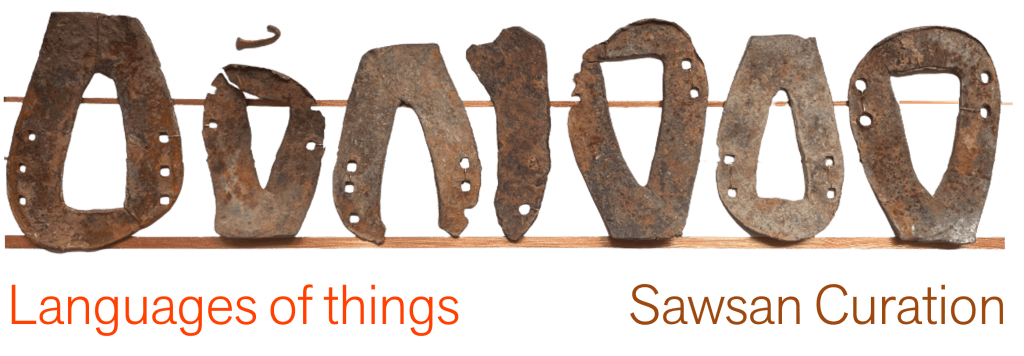
Permanent exhibition of the Saharan Heritage Collection Bert Flint, Marrakesh : Official website
Bla
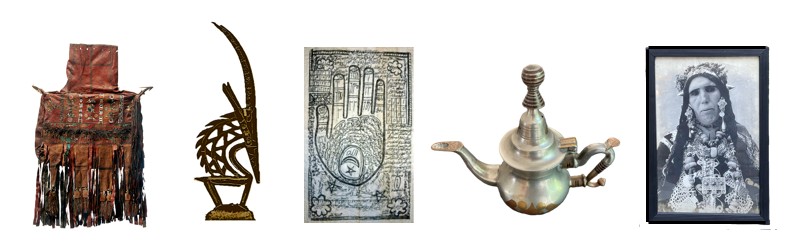
- Open a Tuareg wedding bag
- Unframe an Amazigh photograph
- Inside a Tuareg amulet holder
- Lifting a Bamana crest mask
- Looking into a Mauritanian teapot
OPENING A WEDDING Bag
Frogs in the Sahara ?
Why would an exhibition about the Sahara start with frogs ? Because the frog was and still is represented in many objects in and around the Sahara. You will spot more or less abstract representations here: a very realistic neolithic polished stone sculpture of a frog from Central Sahara, others on locks of doors and boxes of the Dogon people in Mali and kohl containers from northern Morocco. More abstract representations can be found on ladles of Tuareg tribes in Niger, on a cover from Tunisia, or the earthen jar from the Rif. In the south of Morocco, terracotta frogs were still used recently in bath houses as scrubs for pregnant women.
Frogs as a symbol of birth
Indeed – the frog is a symbol standing for birth and renewal: it is related to rain, water, fertility, it has the power to change appearance, and the shape of the legs resembles the squatting position of a women giving birth. Already in ancient Egypt, the frog-headed goddess Heket was invoked to support women during pregnancy and birth giving. With the progressive desertification of the neolithic Sahara, the populations moved to the north and south shores. They brought with them not only their skills, but also their symbols. The frog being one of them.
The Kel Dennek marriage bag
It also became the logo of our exhibition – and more precisely, this frog which is hidden inside a wedding bag of the Kel Dennek Tuareg from today Niger and Mali. From the outside, the bag features decorative leather pieces in Kano green as well as dark and light leather straps, which actually are the ends of embroideries at the inside. But the most striking detail is the frog on the inside of the opening part. Bert carried out field research in Niger and found out that this type of bag is given by the mother to her daughter at her wedding. When the daughter becomes pregnant, she declares it by turning the inside of the bag out so that the frog is visible. After having given birth, the bag is returned again and the frog is hidden inside.
UNFRAMING A PHOTOGRAPH
Designing clothes
At the beginning of the 1980s, when he was around 50, Bert Flint decided to stop teaching and to develop his own creative work. He designed carpets and garments which he wanted to be contemporary creations using traditional Moroccan materials and weaving methods. Some of the clothes were even presented in the exhibition “Variation on the fold” in Paris.
From a clothing shop to the museum
In 1983, Bert opened a textile boutique in his home in Marrakesh. He was collaborating with weavers in the countryside for the fabrics and carpets. During his trips, he continued to build up his collection of rural art crafts. To attract more customers to his clothing shop, he eventually gave lectures once a week and showed his private collection of objects. This is how he ended up transforming his house into a museum in 1989.
The recycled panel
Imagine what I have found when I was working in 2022 in the old Tiskiwin museum: I came across a very expressive photograph of a fully adorned woman of the South Anti-Atlas from the Bou Izakarn tribe, wearing in particular this iconic Amazigh head band featuring five cones. The picture was in a frame which I opened for cleaning – and I discovered that the back panel of the picture frame was … this hand-written shop sign «Come and see our handwoven woolen articles» !
WHAT IS IN AN AMULET HOLDER ?
The amulet vitrine
We saved from the old Tiskiwin museum an original vitrine, and arranged it so as to provide a look and feel of how Bert liked to exhibit the objects. Many of the objects are Tuareg amulet holders. They feature a variety of forms and materials: leather pockets, and metal pieces of different forms, among them the square shaped ones, a small tube fixed on the man’s veil, and the triangle-shaped wedding pectoral worn by women on the chest..
Decoration and effectiveness
All these objects have in common that they are containers for enclosed amulets, that is magic formulas that have a protective function. Importantly, the richer decoration, the more effective is the amulet. Also, reflecting metals increase the power, as they deviate the evil eye, but gold is proscribed, as it is involved in transactions and eventually leads to possession which is considered as burden making nomadic people dependent and unfree. Another important point is that the container should never be opened, otherwise the amulet is not effective anymore.
Looking inside…
A comprehensive study by anthropologists collecting out-of-service amulet holders on a rubbish dump near Dakar over the last 30 years revealed that besides more exotic contents like dried animals or plants – or sometimes just sand – the most frequent amulet is a piece of paper written by someone considered to be skilled in religious and spiritual matters, usually a Marabout or a seer. This person is retributed for his or her services: In the novel “The magicians” by Tuareg writer Al-Koni, a woman consulting the seer to bring back her son offered “a small bottle of perfume, a mirror, incense and four chicken eggs”.
Forms and functions
This example of a written talisman combines excerpts from the Qur’an, names of god, angels, djinns and also real persons; magic figures like magic squares, the hand of Fatima and the Salomon star, and esoteric calligraphy, specially shaping Arabic letters.
The text analyses show that people consult the Marabout for a wide range of issues. From generic ones like keeping bad spirits away or finding love, to much more practical ones: men seek to calm a camel, prevent the rider from falling, find their way during travel; women seek to prevent miscarriages, fight headaches, or bring the man back, but also just prevent the milk from turning sour.
Still, whatever the price, the specific forms and reasons are, these practices reflect but the deeply human need of mastering fears, facing uncertainty, and coping with misfortune, which is present in all human cultures – and I am sure that many of us have their own personal amulet too.
LIFTING A MASK
The social role of the mask
The highlight of the West Africa room is a collection of masks. Masks, however, are much more than just a decorative face covering object, let alone a wall cover. An African mask is above all a spiritual object, connecting the community with supernatural powers and thereby ruling important aspects of individual and social life – such as birth, initiation, worship, fertility, harvests, war and funerals.
Who is behind the mask?
In most African societies, only initiated men wear masks. However, the identity of the mask-wearer is kept secret and the man wears a full costume that completely conceals the body. In this way, the wearer of a mask is no longer regarded as a mere human being, but as a medium embodying the spirit of an ancestor or a deity who acts as an intermediary in the spiritual and social life of the community.
The legend of Chiwara
The antelope masks from the Bamana people in Mali celebrate the divinity Chiwara. The legend tells: “Chiwarawas a half-animal, half-human being, born of a snake and a woman, the first human being.Chiwaracultivated the soil with his nails and a stick given to him by his mother. He was endowed with magical powers that enabled him to transform grass into millet. The crops were so abundant that human beings lost interest in them and no longer paid attention to the harvests. So much so thatChiwaraleft, hiding into the ground. To make amends, the humans built an altar in which his spirit could reside and created crest masks to commemorateChiwara’smemory and teachings.“
Antelopes in agricultural rites
The antelope crest mask are worn on top of the head and appear during agricultural rites, especially the planting and harvest seasons. The vertical horns symbolize the growth of fonio and millet which need light and sun. They always appear in pairs. Male and female are usually distinguished by horns, size, little one. But both are used together by the Chiwara initiation society in dances and agricultural rituals to teach young men farming techniques, social harmony, and the cooperation necessary for community prosperity and fertility of the earth.
LOOKING INTO A TEAPOT
The tea ceremony
This is a Mauritanian tea service travel case. Since the 19th century, when green tea became a widely adopted drink in the Sahara, the tea ceremony is the most important everyday social ritual in Mauritania. Wherever you go, you will be offered tea. It takes about half an hour and three glasses of tea, and allows people to sit down on a mat together, have a rest, exchange news, and get water and new energy.
A modern nomadic object
Whilst this travel case is presented together with other nomadic objects, it is actually a modern nomadic object. On camels, the tea and glasses used to be carried in special reinforced leather bags which were taken off during halts of the caravan. This rigid wooden object however is more recent, and specially made to drink tea whilst sitting in a Toyota pick-up, without even stopping. It is still in use today and produced by the local artisans.
The teapots
Now, let’s have a look inside the travel case. The teapot deserves some attention. Throughout the Sahara, we find two types of teapots: The first one is locally hand-made of cast pewter (étain) – a tin-based alloy – and has a matt finish and a longish pear-shaped form. It is quite heavy and expensive – and the water needs a bit longer to boil. Therefore, locals preferred the round enamel variant, often brown, blue or red, formely imported from Eastern Europe and now mostly rom China.
Adaption to local use and taste
Still, the Mauritanian artisans adapt the imported teapots to the local taste and use cases. The typical Mauritanian features are a prolongation of the spout to avoid dropping and facilitate serving from above, a ring-shaped footer to put it on the charcoal, the handle and the lid to make it easier to grip and less sensible to heat, as people very often during the ceremony just open and close the lid to look at the tea boiling.
Layered decorations
Added pieces are of typical Mauritanian craftsmanship. They feature geometrical copper and brass pieces and decorations, which are hammered or soldered into place. But the most interesting ones are the very nice layered pieces on the lid and the handle which are thin layers of copper, brass, white metal and black wood – or modern plastic replacements. In Mauritania, I have asked an artisan to show me how they produce these pieces: they are made of small individual discs with a hole in the middl. The discs are first put onto a support rod like beads, then fixed and filed down from the outside to give them the desired shape.
 Sawsan Curation